


Music
original indie chamber folk
Drawing from a diverse range of influences including indie folk, anti-folk, old time, classical, ambient, hip hop, alternative rock, and the blues, Kristen Leigh's music weaves together themes of trauma, resilience, vulnerability, courage, grief, spirituality, and joy into unique compositions that are at once both playful and provocative. Rotating between guitar, piano, ukelele, and her trusty shruti box, Kristen's live sets often feature a roving band of instrumentalists who help bring her songs to life on strings, accordion, banjo, and of course, Father Joe and his dancing chicken!

"Intuitive perceptive compositions and compelling performance!"
-Mark Wingerter
The Carolinian
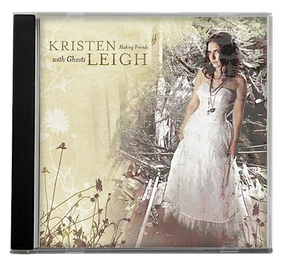
"Making Friends with Ghosts"
originally released 2010
Re-mastered in 2023


Featured tracks
biblical songs
"song of sitidos" (Job 2:9)
Written while studying the Hebrew Bible with Dr. David Carr, "Song of Sitidos" is a song about the book of Job written from the perspective of Job's wife. We usually think of Job as the guy who loses everything, but he doesn't lose his wife. She lives. Which means she also loses everything he loses. I wanted to explore the experience of grief as described in this ancient book from her perspective.

"when all hope is gone" (John 11:35)
An exegetical exploration of the shortest sentence in the Bible: "Jesus wept." I wanted to dig more deeply into this uniquely human depiction of Jesus in the Gospel of John, and to see what it would feel like to sing from Jesus' perspective. This moment of grief occurs in the midst of a conversation with Mary of Bethany, who blames Jesus for the death of her brother Lazarus. Following an intuition that linked this moment with Mary Magdelene and her ability to recognize Jesus' body beyond death at the empty tomb, I wrote this song from a perspective that has now found scholarly support in the work of Elizabeth Schrader Polczer.
liturgical Chant & Paperless singing
"Those who sing their praises double them," wrote St. Augustine, "because of the joy and love that belongs to those who sing." When communities sing together, the bonds of faith, connection, and healing are strengthened. Singing is one of humanity's oldest forms of communication, and one of the most universal spiritual practices. It simultaneously engages the heart, mind, and body in ways that knit us together as one, even while allowing us to maintain our own individual identities.
Human beings are born with an innate capacity to sing, but many people struggle to find their voice due to unhelpful messages we receive from family members, choir directors, and popular culture. With over a decade of experience leading congregational & communal singing, I am committed to helping people find ways to participate more deeply and meaningfully in liturgical worship through music.

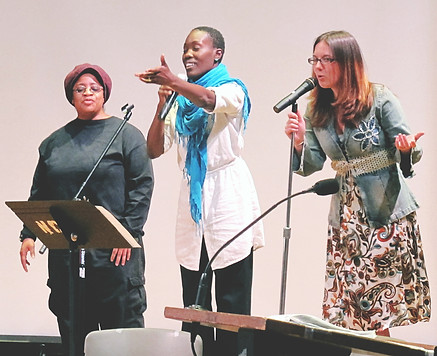
"Our church never sounded so good singing as they did last night. Thank you."
-Kate Guthrie, Senior Pastor
New Creation Presbyterian Church
Paperless singing is a communal chant tradition that emphasizes listening, self-awareness, harmony, and community connection, bridging the gap between the so-called "traditional" and "contemporary" expressions of modern worship music. For most of Christian history, songs were learned aurally through mimetic call and response patterns, and were sung without any sheet music or printed lyrics. Paperless singing offers a "new" way of entering into this ancient tradition, utilizing an extensive vocabulary of visual and sonic "cues" that invite congregations into a shared sense of communion through singing. Learn more
With training from:

Taize Chant
Anglican Chant
Paperless Singing
Songs of Presence
Contemplative Chant
Responsorial Psalms
Gaelic Chant
Old-Time & Bluegrass
Contemporary Worship
African American Spirituals
Offertory Anthems
Weddings & Funerals
Music for Meditation
chant & hymn recordings
approach to liturgy & worship
relational
Liturgy creates "thin" places, where the boundaries between ourselves, others, and God become more porous. Authentic engagement with music (whether presentational or participatory!) has the power to bind us together in solidarity with one another, opening us individually and collectively to the movement of the Holy Spirit. Particularly whenever we sing together, we breath together, and our heart rates align in an embodied experience of acoustic communion.
CONTEXTUAL
There can be no "one size fits all" approach for liturgy and music. What is experienced as welcoming, transformational, engaging, reverent, or even "singable" in any given context may not necessarily translate very well into another community. Considerations like rhythm, tempo, lyrical content, style, and instrumentation are all highly contextual. What is "appropriate" for worship can depend on a variety of factors that includes geographic region, demographics, denomination/tradition, church season, and practical aspects of the space.
formational
The deep spirituality at the heart of the Christian liturgical tradition is not meant to simply entertain us, but to challenge and shape us at the level of mind, heart, and body. Worship should be an authentic expression of Christian praxis that allows us to practice our faith in both action and reflection. Music in worship facilitates spiritual growth through a complex interplay of rhythm, melody, and lyrics. I consider the formational aspects of music through a variety of lenses: theological, psychological, aesthetic, cultural, and historical.
diversity
Liturgical style should always strive for a balance between comforting familiarity and opportunities for new learning and growth. Respect for local traditions and languages should be balanced with an effort to incorporate diverse traditions from the broader denomination, while also remaining open to the movement of the Holy Spirit to allow for creative engagement with new and emergent styles and unexpected moments of liturgical meaning-making that happen spontaneously.

creative liturgy & worship design
I have over a decade of experience planning liturgy and worship for churches, retreats, festivals, and religious conferences. Drawing on diverse artistic influences, deeply collaborative and improvisational sensibilities, and ecumenical/interfaith considerations from my years of planning worship at Union Theological Seminary in New York City, I can design liturgical spaces and meaningful, multivalent rituals that speak to particular communities, denominations, church seasons, Biblical themes, and prayerful intentions. I've been honored to plan liturgies and facilitate prayer and worship in Episcopal, Roman Catholic, Presbyterian, Methodist, Lutheran, UCC, Quaker, Baptist, UU, and interfaith contexts.
workshops & classes
singing as a spiritual practice
This workshop draws on ancient advice from St. John Chrysostom for singing together in Christian community, which is something that everyone was meant to participate in. We'll look at the five inner postures that give spiritual depth to our singing (regardless of our level of musical skill!), and discover how singing in any context - religious or secular - can draw us into a deeper sense of connection with our bodies, one another, and with God. We will learn songs from a variety of participatory singing traditions, including African American spirituals, songs from Iona, Songs of Presence, Taizé chants, Music That Makes Community, and more.


The spiritual Discipline of chant
This workshop introduces the history of chant as a spiritual discipline in the Christian liturgical tradition. We will compare Eastern and Western chant traditions, and examine the ancient roots of chant through the practices of Jesus, the early disciples, and the desert fathers and mothers. We will learn how to chant (which differs from other kinds of singing), and understand the purpose of chant as it developed in both monastic and secular liturgical settings. We will also look briefly at some of the current living traditions of chant including Gregorian, Anglican, and Taizé. Participants will gain a better understanding of how to more fully engage in liturgical chant, as well as how to incorporate singing and chant into everyday life.
singing for social change
Music has always played an important role in movements for social change. We will reflect on examples of musical protest and civil disobedience from antiquity and the middle ages all the way up to today, looking particularly at the role of the spirituals in the time of slavery and the Civil Rights Movement. We will also look at song of protest written during the folk revival of the 1960s, the punk era, and hip hop, examining some of the more subtle ways that prophetic meaning can be conveyed through different musical genres and styles. Participants will come away with a deeper sense of how musical meaning is constructed, and why and how music can move people to change the world.


What Is "Sacred Music"?
This class offers a critical examination of what we mean when we speak of "sacred music," and how this relates to various forms of liturgical and religious music, as well as popular songs with religious or Christian themes. Tracing the notion of the "devil's music" back to the ancient Greeks, we'll look at examples from early Christianity, the Middle Ages, the Enlightenment, and the 20th century to begin expanding our understanding of the complex relationship between music, language, and religion. Participants will be challenged to extend their appreciation of sacred music to genres and styles they may not have previously considered.
building vocal community
No prior music knowledge is necessary for this interactive singing workshop designed especially for people and communities who think they can't (or shouldn't) sing. We begin by unpacking some of the unhelpful messages that participants may have received about their own singing from teachers or family members, and use simple breathing and vocal exercises to gently unleash our collective voice in a non-judgmental atmosphere. Seasoned singers and "non-singers" alike will build skills for singing more confidently in a group.


song leader trainings
I work with clergy, music directors, cantors, and congregational lay leaders to learn how to lead community singing and invite more congregational participation through the skills and methods of paperless singing. Formal music education or training is not required! All you need is a relatively good sense of pitch, a steady sense of rhythm, and the confidence to be vulnerable in front of a group (which is sometimes the hardest part!). I can offer one-on-one trainings as well as interactive small group sessions to guide participants in practicing their song leadership skills in a supportive group atmosphere.
clergy & church consulting
Do you want to...
-
Design a new liturgy around a specific theme or special event?
-
Integrate more diverse styles or traditions while avoiding cultural appropriation?
-
Expand your church's music repertoire beyond "traditional" and "contemporary"?
-
Resolve community conflicts about music, worship, or liturgical expression?
-
Encourage greater congregational participation in singing and worship?
-
Develop your own skills as a cantor or worship leader?
Good Friday Blues @ St. Marks in the Bowery
From 2012-2014, I assisted Music Director Jeannine Otis & Rev. Winnie Varghese with planning and performing in this annual liturgy, which combines the traditional BCP Episcopal Good Friday service with a powerful musical and theatrical performance of the Passion narrative according to John's Gospel. This performance/liturgy features Grammy-award winning singers and instrumentalists from around New York City.
conflict resolution
There has never been a time in the history of the church when Christians have not engaged in disputes over music and worship, including issues relating to:
-
instrumentation
-
lyrical content
-
harmony
-
rhythm
-
improvisation
-
presentational style
-
level of congregational involvement
-
new variations or interpretations of "old" hymns
-
incorporation of "popular" tunes and styles


research
At nearly every point in church history, "old" and "new" styles of music have been debated and critiqued, for precisely the same reasons we criticize "traditional" and "contemporary" styles today. These ongoing tensions reflect a necessary dialectal process in the discernment of what it means to live more fully into faithful Christian witness in a particular time and social context.
Conflicts can arise between clergy, music directors, and congregations about what kind of music is most beneficial or "appropriate" for worship, often rooted in different assumptions about the nature of music and its role in liturgy. All parties involved tend to lean on personal and secular values, rather than Christian values, in order to defend their positions.
As a layperson with training in both Western classical music and folk/popular styles, as well as ecumenical training in liturgical design from Union Theological Seminary, and undergraduate training in dialogue and conflict management, I am uniquely positioned to offer nuanced guidance and practical support for churches struggling to articulate a shared theology of music. Leaning on my extensive research about music in the history of the church, I can help ground conversations about liturgy and worship with a balanced view of the theological, ecclesial, aesthetic, and practical issues.
"Your historical diagnoses and concrete suggestions were very helpful in beginning to think through our contemporary Eucharist."
-Rev. Drew Harmon, Associate Rector
Saint Francis Episcopal Church
Decolonizing worship music
One of the most complex issues faced by the church today is the question of how we reconcile our Christian faith with the legacy of violence and oppression caused by centuries of European colonization and slavery. Nowadays, most liturgical churches tend to "outsource" the training of their organists and choir directors to secular academic institutions rooted in Western art music traditions that often maintain very different perspectives from churches and seminaries on what defines "sacred music."
Some of the most prominent Western art music programs today still use curriculums that were developed in the 19th century with the explicit intent of promoting a white Eurocentric "canon" that supported notions of Western secular art music's superiority over the "primitive" musics of cultural others. This ideology is still baked in to many of the standard teachings on music theory and music history. As a result, attitudes and assumptions about music and culture that are antithetical to Christian values can still subtly influence the embodied postures, attitudes, and aesthetic values of trained church musicians and music directors.
The process of "decolonization" does not mean simply throwing out old church hymnals, getting rid of organ music, and replacing the long and blessed tradition of choral harmony with guitar-based performances or African American spirituals. Indeed, many of the most beloved arrangements of the spirituals from prominent Black composers draw on their own mastery of the Western classical art music style.
In most cases, top-down attempts to incorporate more culturally diverse aesthetics, especially in communities of privilege, often result in a replication of colonial patterns and promote the objectification of cultural others through ingrained patterns of appropriation. Deeper education, formation, and discernment is needed to determine what "decolonization" might look like within any particular worshipping community. This is longer work that requires a confrontation with specific local people and histories as well as a mature community-wide grappling with the nature of music itself, and its relationship to liturgy and worship.
articles for further study

Experiments & experiences
wild goose festival
In 2011, I worked alongside the organizers of the first Wild Goose Festival to coordinate a team of 8 production staff and 23 support volunteers, to oversee sound and staging for this NC-based festival exploring the intersections of art, music, spirituality, and social justice. The following year, I traveled with the planning committee to Cheltenham, England to meet with the organizers of the Greenbelt Festival, to strategize planning and bring back more ideas, including the "Beer & Hymns" pub sing. I have performed at the Wild Goose Festival several times since then and remain an active part of the Wild Goose community online.
good friday blues
From 2012-2014, I assisted Music Director Jeannine Otis & The Rev. Winnie Varghese with planning and performing in this annual event held at St. Mark's Episcopal Church in the Bowery - the oldest church in New York City. This powerful and moving service combines the full, traditional Episcopal Good Friday service from the 1979 Book of Common Prayer with a powerful musical and theatrical performance of the Passion narrative according to John's gospel, featuring Grammy-award winning singers and instrumentalists from across New York City.

"Beer & Hymns" pub sing-along
Beer & Hymns is a community singing tradition that got started at the pub tent of the annual Greenbelt Festival in 2006 in Cheltenham, England. I traveled to Greenbelt in 2011 with the planning team of NC's Wild Goose Festival to gather ideas for the second festival season. The American version of Beer & Hymns was introduced at the 2012 Wild Goose Festival, featuring rousing renditions of bluegrass gospel hymns, African American spirituals, and folk Americana tunes spanning generations. It was an instant hit. Festival attendees brought this communal singing tradition back home with them, and Beer & Hymns sing alongs started popping up at pubs and tap rooms all over the country.
From 2016-2020, I hosted a monthly Beer & Hymns pub sing at Four Saints Brewery in downtown Asheboro, NC, which helped build bridges and create community in an area that had recently transitioned from being a dry county.

nightwatch Youth program
From 2010-2013, I served as a congregational song leader and liturgical assistant for a weekly overnight youth lock-in program at the Cathedral of St. John the Divine in New York City, where we invited middle and high school kids from across the northeast to an overnight lock-in with singing, an organ demonstration, a candlelit labyrinth walk, and a midnight mass in the cavernous beauty of the fourth largest cathedral building in the world.

Taizé Advent Retreat
From 2016-2018, I prepared and led the annual Advent Taizé Retreat at St. Francis Springs Prayer Center in Stoneville, NC, planned in collaboration with Father Luis Canino, friend and director of the retreat center. This experience combined a brief introduction to the history of the Taizé community and the experience of congregational prayer through chant singing, with a candlelit program of chants and Scripture readings for the liturgical season of Advent. I coordinated a small chamber ensemble of guitar, bass, piano, clarinet, oboe, flute, cello, and harp, providing musical arrangements and direction.


To book music for a worship service, retreat, wedding, funeral, conference, or other special event, please fill out the contact form at the bottom of this page. For Sunday worship services, please provide your church's name, denomination, average Sunday attendance, and the typical length of a service.
My standard fee is $250 per service, with a sliding scale for smaller churches with a limited budget and other special circumstances. I charge a smaller fee for solo performances (offertory or communion anthems), choral supply, and instrumental accompaniment, and a higher fee for retreats, conferences, weddings and other special events that are longer and/or require a greater level of preparation.
